
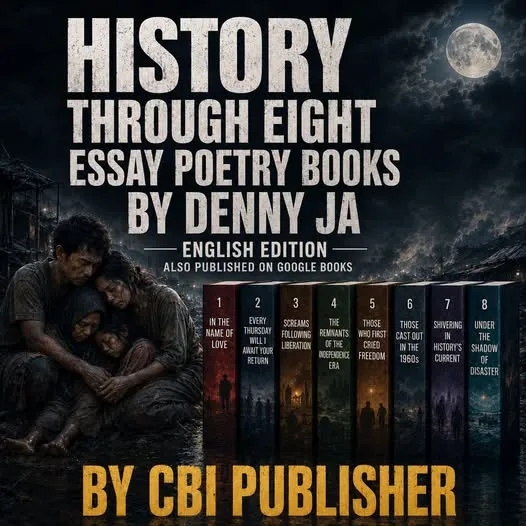
- Also Published on Google Books
By CBI Publisher
A father walks eighty kilometers barefoot, calling the names of his wife and children who have disappeared.
In another land, an elderly woman still reads the letter her husband never lived to receive because of the Hiroshima bombing.
Elsewhere in history, an Indonesian woman waits every Thursday for the husband who vanished, holding onto hope for more than a decade.
They never knew one another. Yet literature brings them together within the same imaginative space. There, history ceases to be a collection of statistics and becomes instead a human face, a stream of tears, and the beating of a living heart.
-000-
History is often written by the victors. Literature, by contrast, seeks those who were defeated, marginalized, or quietly erased from memory.
Out of that conviction emerged the genre of Essay Poetry, first introduced by Denny JA in 2012. It brings together three elements that rarely coexist within a single literary form: historically verifiable facts, the dramatic freedom of literature, and social reflection that invites readers to think beyond the page.
Within Essay Poetry, historical figures and the victims of history are brought back to life through lyrical narrative. Historical accuracy is preserved through footnotes and documented sources, while the imagination fills the emotional spaces that official archives have never been able to record.
The result is not a new version of history, but a new way of experiencing it.
This distinctive approach has earned Essay Poetry international recognition. When Denny JA received the BRICS Award 2025 for Literary Innovation, one of the reasons cited by the organizers was his success in creating a literary form that bridges historical documentation with the emotional experience of humanity.
The publication of these eight Essay Poetry books in English continues that vision, allowing the stories of Indonesia and the shared tragedies of humankind to reach readers across the world.
-000-
To enter the inner world of Denny JA’s essay poetry, here is a concise introduction to each of the eight volumes.
1. In the Name of Love (2021), translated from Atas Nama Cinta (2012)
Everything begins with love. Yet in a world burdened by prejudice, love is often the first casualty. The five essay poems in this volume reveal how discrimination based on race, religion, sexual orientation, social status, and cultural boundaries repeatedly strips people of their dignity. Grounded in historical reality and enriched by literary imagination, each story transforms statistics into deeply human experience.
One of the book’s most unforgettable scenes follows Fang Yin, a survivor of the May 1998 riots, as she burns the handkerchief once given to her by the man she loved. Together with the cloth that had absorbed thousands of tears, she tries to burn away her trauma without erasing her memory.
This volume reminds us that the greatness of a civilization is measured not by the height of its buildings, but by its willingness to protect those most easily cast aside. In the end, love is more than an emotion. It is the courage to defend our shared humanity while the world remains occupied with building walls of division.
-000-
2. Every Thursday Will I Await Your Return (2021), translated from Kutunggu di Setiap Kamis (2018)
Every Thursday, Lina returns once more. She carries a hope that grows thinner with each passing year, yet never disappears completely. Since her husband became one of the victims of enforced disappearance during Indonesia’s Reformasi in 1998, waiting has ceased to be an act and has become a way of life. Standing before the Presidential Palace alongside other families of the disappeared, her private grief gradually transforms into a public struggle for justice.
Years later, Lina still sets aside a slice of birthday cake and tells her son that one day his father will come home. To the outside world, this may seem like denial. To love, it is the quietest and most enduring form of faithfulness.
Through this story, essay poetry reveals that human rights violations never end with those who vanish. Their wounds are inherited by those left behind to live without certainty. History, in turn, acquires a human face, a name, and tears.
-000-
3. Screams Following Liberation (2022), translated from Jeritan Setelah Kebebasan (2022)
Some celebrations of freedom are greeted with applause. Others are followed by screams. This volume enters one of the darkest chapters of Indonesia after the Reformasi of 1998, when the fall of an authoritarian regime did not automatically bring peace. Through twenty-five essay poems, Denny JA traces the scars left by the May 1998 riots, as well as the communal violence in Sampit, Lampung, Lombok, and Maluku.
Here, history is no longer a record of casualties. It becomes a burning home, a mother running in terror, a missing child, and a father waiting for a miracle.
Among the book’s most heartbreaking figures is Koh Enlai. For twenty-four years, he clings to the hope that his daughter, Lian, is still alive because her body was never found. Then, one quiet night, he lights a dragon candle and whispers, “Dance peacefully in the world beyond, my child.”
This volume asks a haunting question. What does freedom truly mean if human beings continue to be consumed by hatred?
-000-
4. The Remnants of the Independence Era (2024), translated from Yang Tercecer di Era Kemerdekaan (2024)
History almost always remembers its victors. This volume searches instead for those left behind. Through fifteen essay poems, Denny JA brings back the forgotten stories of Romusha forced laborers, women compelled into sexual slavery as comfort women, and the nyai, Indigenous concubines who were stripped of both rights and dignity under colonial rule.
Among these stories, Aunt Inah stands as the embodiment of a lifetime of waiting. For more than half a century, she calls out the name of her son, Elmo, who was taken to Europe by his Dutch father. As death approaches, she embraces a bolster as though it were her child, then leaves this world without ever seeing him again.
This volume reminds us that history is not only about wars and declarations of independence. It is also about tears that never found their way into school textbooks. Through poetry, those once forgotten recover their names, their faces, and their dignity.
-000-
5. Those Who First Cried Freedom (2026), translated from Mereka yang Mulai Teriak Merdeka (2025)
Long before Indonesia became independent, there were men and women courageous enough to imagine that freedom was possible. This volume brings the pioneers of the national awakening back to life, not as monuments carved in stone, but as human beings who loved, doubted, sacrificed, and suffered. From Tjokroaminoto to Ki Hajar Dewantara, their journeys are reimagined through the union of meticulous historical research and the evocative power of poetry.
The most unforgettable story is that of Sutan Sjahrir. One of the founders of the nation, who dreamed of building a democratic republic, ultimately spent his final years as a political prisoner in the very country he had helped create.
Through this profound paradox, the book reminds us that history does not always treat its pioneers with justice. True freedom endures only when courage walks hand in hand with justice and humanity.
-000-
6. Those Cast Out in the 1960s (2026), translated from Mereka yang Terbuang di Tahun 1960-an (2024)
They did not always die. Yet their lives were uprooted from the land that had shaped them. Such was the fate of thousands of Indonesian exiles after the political upheaval of 1965. Losing a passport proved far more devastating than losing an address, for with it disappeared family, the future, and the right to return home.
This volume does not defend an ideology. It defends the most fundamental human right of all: the right to belong to a homeland and to one’s memories. Across sixteen essay poems, it gives voice to those erased from official records, yet never erased from the memory of their nation.
One man keeps his engagement ring for fifty-eight years. When he finally returns, the woman he loved has long since been laid to rest. All he can do is place the ring upon her grave. His promise arrived too late, but his love never departed.
In the end, exile is not defined primarily by distance. It is the wound of continuing to love a country that no longer acknowledges your existence.
-000-
7. Shivering in History’s Current (2026), translated from Yang Menggigil dalam Arus Sejarah (2025)
How could two armies locked in history’s greatest war step out of their trenches and play football together? That question opens the door to this volume’s journey through some of the world’s greatest tragedies, from the Holocaust and Hiroshima to the French Revolution, the Russian Revolution, and China’s Cultural Revolution.
Behind every monumental event, Denny JA searches for ordinary people swept away by the relentless current of history. Statistics are transformed into faces, names, and tears.
The Christmas Eve Truce of 1914 becomes the book’s most unforgettable scene. Soldiers emerge from their trenches, exchange chocolate, shake hands, and play football together. The following morning, they are ordered once again to fire upon one another.
This volume reminds us that even at the very heart of war, humanity can still sing longer than hatred can endure.
-000-
8. Under the Shadow of Disaster (2026), translated from Atas Nama Bencana (2026)
It begins with mud. Not ordinary mud, but mud that carries away the names of children, the remains of homes, and the last forests swept away by the great Sumatra floods of 2025 and 2026. This volume sees disaster not merely as a natural phenomenon, but as the long consequence of humanity’s fractured relationship with the natural world.
Amid the devastation emerge unforgettable figures: a mother holding her child tightly to keep the floodwaters from carrying them away, a teacher walking hundreds of kilometers in search of his mother’s body, and a Tapanuli orangutan mourning the loss of its last remaining home.
Yet the most haunting image is that of a father walking eighty kilometers barefoot while calling the names of his wife and two children. When the rest of the world has surrendered, his love continues to move forward.
The volume leaves readers with one quiet truth. A planet that we fail to protect will, in the end, no longer be able to protect us.
-000-
These eight volumes trace a remarkable journey, beginning with love shattered by discrimination, moving through the families of victims of enforced disappearance, primordial conflicts, the lingering wounds of colonialism, the pioneers of independence, the exiles of 1965, the great tragedies of world history, and finally the ecological catastrophe that struck Sumatra.
Their scope steadily expands, from the intimate realm of individual lives to the destiny of a nation, then to the currents of world history, and ultimately to a wounded planet.
Yet their moral center remains unchanged. At the heart of every volume stand the victims of history: people violated by their age, banished by their own country, erased from school textbooks, or deprived of their children, their beloved, their homeland, or the last forests they called home.
Through essay poetry, Denny JA transforms history from a chronicle of victors into a homecoming for those who suffered. He restores to them their names, their tears, and their dignity.
Three defining strengths distinguish this series from many works of popular history.
First, it moves history from the archive into the inner life. Statistics become names, families, and faces.
Readers no longer remember only “six million victims of the Holocaust.” They remember a child who lost his mother at Auschwitz.
This transformation reflects the findings of psychologist Paul Slovic on psychic numbing, the tendency for human empathy to diminish when suffering is presented only in the form of statistics.
Second, historical fact and literary imagination are brought together without diminishing one another. Every poem rests upon verifiable historical research, while its dramatic elements bridge the emotional silence that archival records can never preserve.
In this way, literature complements historiography rather than replacing it.
Third, the entire series is guided by moral courage. These eight books do not ask who prevailed. They ask who suffered. Their attention is directed not toward rulers, but toward victims. In doing so, literature fulfills one of its highest ethical purposes by safeguarding collective memory.
-000-
The following two books further deepen our understanding of how history can be transformed into literature and how literature, in turn, can illuminate history.
The first is War and Peace by Leo Tolstoy, published in 1869.
Few literary works have changed the world’s understanding of history as profoundly as War and Peace.
Written in the aftermath of the Crimean War, at a time when Russia was questioning its national identity and the meaning of leadership, Tolstoy chose a path radically different from official historiography.
He refused to place Napoleon or Tsar Alexander at the center of his narrative. Instead, he invited readers into family dining rooms, battlefields, intimate conversations, and the inner anxieties of ordinary men and women.
In Tolstoy’s hands, history no longer advances through the will of a single heroic figure. It unfolds through millions of small decisions made by ordinary people in the course of everyday life.
This vision became a powerful critique of the Great Man Theory of History, which attributes historical change primarily to extraordinary individuals.
The influence of War and Peace on world literature has been immense. The novel helped establish the foundations of modern historical fiction, a literary tradition that combines rigorous historical accuracy with profound psychological insight.
Writers from Hilary Mantel to Anthony Doerr have continued this tradition, sharing the conviction that literature can reveal dimensions of human experience beyond the reach of conventional historiography.
Denny JA’s essay poetry moves within the same intellectual tradition, although it adopts a different literary form. Where Tolstoy resurrects history through the novel, Denny JA employs essay poetry grounded in documented historical fact, supported by footnotes, and enriched by the dramatic inner lives of history’s forgotten victims.
Both writers share the same fundamental conviction. History can never be fully understood through chronology and data alone. It truly comes alive only when readers are able to experience the fear, love, loss, hope, and courage of those who once lived through it.
In this way, literature does not compete with history. It restores the soul to history itself.
-000-
The second book is The Things They Carried by Tim O’Brien, published in 1990.
This remarkable work demonstrates how historical fact acquires greater depth through literature.
The Vietnam War is presented not merely as a military conflict, but as a psychological burden carried by every soldier who survived it.
O’Brien draws an important distinction between factual truth and story truth. At times, an imagined story can convey an emotional truth more powerfully than a strictly factual account.
This insight explains why historical fiction plays such an essential role in cultivating empathy for the past.
-000-
In a conversation with CBI Publishers, Denny JA reflected:
“As a writer, I have repeatedly discovered that statistics possess only a short memory, while stories endure for generations.
When I read archival records about thousands of victims, I gain knowledge. But when I write about a father calling out his child’s name while walking through endless mud, I become a witness myself.
I have come to believe more deeply than ever that literature is not an escape from reality. It is a more profound way of entering it.”
Some argue that history should remain exclusively in the hands of historians, while literature risks blurring the boundary between fact and imagination.
This concern deserves to be taken seriously. Scholarly rigor should never be compromised. Yet essay poetry does not seek to replace historiography. It seeks to complement it.
Historical fact remains the foundation. Imagination simply breathes life into the emotional spaces that archives can never record. History provides the framework. Literature gives it a heartbeat.
-000-
Yet it is precisely at the meeting point of fact and imagination that essay poetry faces its greatest challenge. Every act of dramatization carries the possibility of simplification, the loss of historical nuance, or the adoption of a perspective shaped by inevitable bias.
For that reason, readers should preserve a critical awareness while also recognizing the ethical power of this literary form.
Ultimately, these eight volumes of essay poetry demonstrate that history does not end when wars cease, regimes collapse, or disasters subside.
Precisely because they seek to gather so many historical wounds into the language of poetry, these books confront both an aesthetic and an ethical test.
The dramatization that awakens empathy inevitably risks simplifying the complexity of history, while factual documentation may guide readers toward particular interpretations.
Their greatest challenge lies in maintaining equilibrium, allowing history to remain intellectually rigorous, literature to remain genuinely poetic, and human suffering to retain its full moral depth rather than becoming an object of sentimental fascination.
History truly ends only when humanity ceases to remember it. For that reason, literature bears a responsibility no less important than historiography. Its task is to ensure that suffering never dissolves into silence.
History records those who prevailed. Literature ensures that those who suffered are never forgotten.
⸻
Jakarta, June 28, 2026
REFERENCES
1. War and Peace. Leo Tolstoy. The Russian Messenger, 1869.
2. The Things They Carried. Tim O’Brien. Houghton Mifflin, 1990.
3. The Content of the Form: Narrative Discourse and Historical Representation. Hayden White. Johns Hopkins University Press, 1987.
4. Poetic Justice: The Literary Imagination and Public Life. Martha C. Nussbaum. Beacon Press, 1995.
5. Regarding the Pain of Others. Susan Sontag. Farrar, Straus and Giroux, 2003.
-000-
The Eight English-Language Editions of Denny JA’s Essay Poetry Series on Google Books
The editions are also available through Google Books:
1. In the Name of Love (2021), translated from Atas Nama Cinta (2012)
https://play.google.com/store/books/details/In_the_Name_of_Love_Essay_Poetry_Related_to_Issues?id=l7gqEAAAQBAJ&hl=en_GB
2. Every Thursday Will I Await Your Return (2021), translated from Kutunggu di Setiap Kamis (2018)
https://play.google.com/store/books/details/Every_Thursday_Will_I_Await_Your_Return_A_Love_Sto?id=-KYqEAAAQBAJ&hl=en_GB
3. Screams Following Liberation (2022), translated from Jeritan Setelah Kebebasan (2022)
https://play.google.com/store/books/details/Screams_Following_Liberation_The_Drama_of_Indonesi?id=Vt6fEAAAQBAJ&hl=en_GB
4. The Remnants of the Independence Era (2024), translated from Yang Tercecer di Era Kemerdekaan (2024)
https://play.google.com/store/books/details/The_Remnants_of_the_Independence_Era_Essay_Poetry_?id=OezuEQAAQBAJ&hl=en_GB
5. Those Who First Cried Freedom (2026), translated from Mereka yang Mulai Teriak Merdeka (2025)
https://play.google.com/store/books/details/Those_Who_First_Cried_Freedom_An_Essay_Poem_Series?id=tuvuEQAAQBAJ&hl=en_GB
6. Those Cast Out in the 1960s (2026), translated from Mereka yang Terbuang di Tahun 1960-an (2024)
https://play.google.com/store/books/details/Those_Cast_Out_in_the_1960s_Told_Through_a_Series_?id=jKvuEQAAQBAJ&hl=en_GB
7. Shivering in History’s Current (2026), translated from Yang Menggigil dalam Arus Sejarah (2025)
https://play.google.com/store/books/details/Shivering_in_History_s_Current_Fifteen_Dramas_of_W?id=g4PuEQAAQBAJ&hl=en_GB
8. Under the Shadow of Disaster (2026), translated from Atas Nama Bencana (2026)
https://play.google.com/store/books/details/UNDER_THE_SHADOW_OF_DISASTER_A_Collection_of_Essay?id=CITuEQAAQBAJ&hl=en_GB
Rubrik Khusus
HISTORY THROUGH EIGHT ESSAY POETRY BOOKS BY DENNY JA, ENGLISH EDITION
30 Jun 2026
-
Sumber Foto: DennyJAWorld
